Frankly, My Dear, Search This Blog

Showing posts with label Lucille Ball. Show all posts

Tuesday, August 6, 2013

Happy birthday to the Lucy I love


The sun never sets on Lucille Ball. All over this worried world tonight, nations of untold million are watching reruns they also watched the first time around. Joy requires no translation. God wanted the world to laugh, and he invented you. Many are called, but you were chosen. All of the funny hats, the baggy pants, the mustaches and the wigs, and the pratfalls and the blacked out teeth - they didn't fool us one minute. We saw through all the disguises, and what we found inside is more than we deserve. - Sammy Davis, Jr

Though I have been doing a less than decent job of it lately, I have, actually, been keeping this blog for two full years now. And in this time we've spent together, I think I've made it clear on numerous occasions just how much I love Lucille Ball. Hell, I even wrote a letter to her last fall. She's not just my favorite actress, she's my favorite person and one of my biggest inspirations.

So, on the occasion of her one hundred and second birthday, I don't really know what I could tell you about her that I haven't already said. Or how I could thank her in some new, special way for all she's given me - laughter and otherwise. Thus, this isn't going to be some incredibly long or wonderful post that I'm particularly proud of. But I hope it gets the message across.

People fall in love with Lucy Ricardo. Lucille Ball wasn't much like Lucy Ricardo at all, and this comes as a disappointment to some. I love Lucy Ricardo as much as the next person, but it's Lucille Ball I'm enamored with. I hear a lot about the tragic lives of the Marilyn Monroes, their sometimes eccentric behavior excused by the ordeals inflicted upon them. Lucille Ball suffered, in many ways, just as much and was never given that pass or exemption for her emotions. Perhaps it was because Lucy had a persistence in her to not fall into patches of vulnerability. And following her divorce from Desi, she built a shield of armor around herself.

I've said this before, but I'll say it again: the piece of film that I feel displays the true, human Lucy is not I Love Lucy or any of the television shows that followed it; it's not any of her movie work. It's her home movies. Though she loved her fans and gave them more due respect than, perhaps, almost any other star (except maybe Joan Crawford), stardom always seemed to make her a bit uncomfortable. Robert Osborne became friends with her in the 1960s and once shared an anecdote that I feel is very telling. Around the time of her divorce from Desi, she was an emotional wreck, and needed to get away from their home and the memories that haunted her there. So she would come to Osborne's house and lie on his couch for hours and sob. From his apartment, you could see the lights of Los Angeles twinkling below, and Osborne made a comment to her that he hoped would raise her spirits. "It's a wonderful feeling to know that every one of those lights out there, you just have to say the word 'Lucy' - you don't even have to say the last name, and they know it's you," he told her. But this frightened her. She said in response, "Oh God, don't say something like that! That's terrifying."

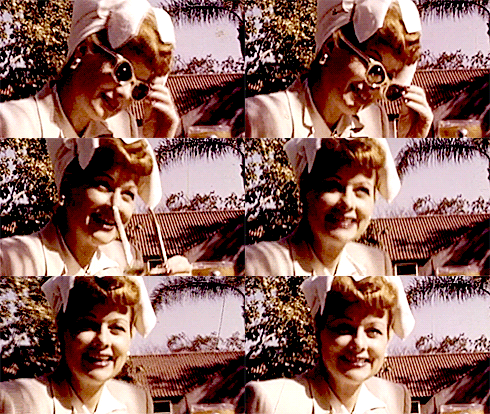
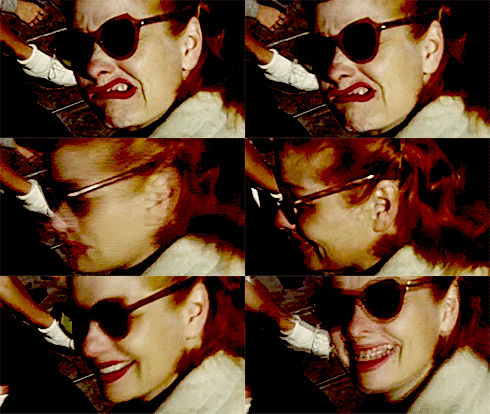
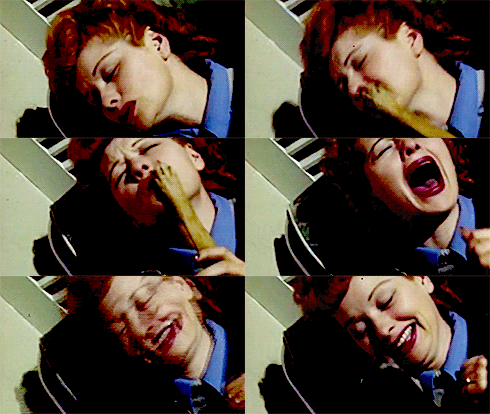
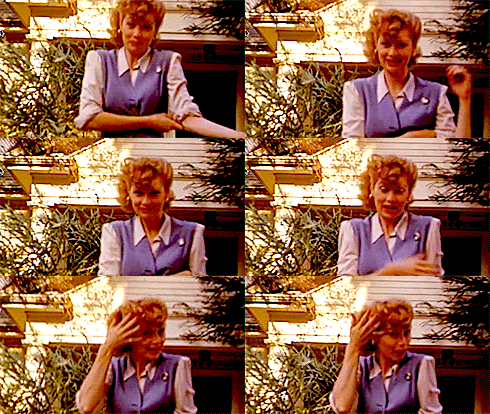
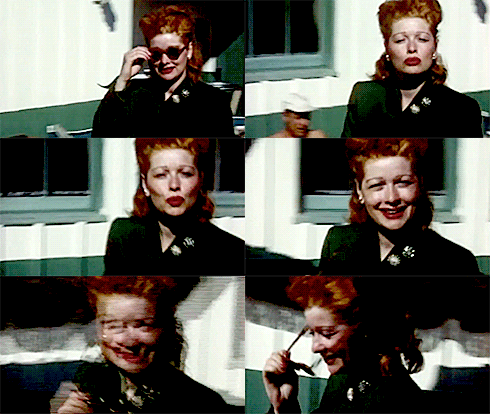
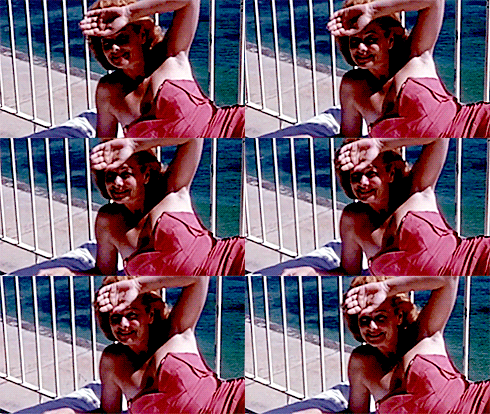
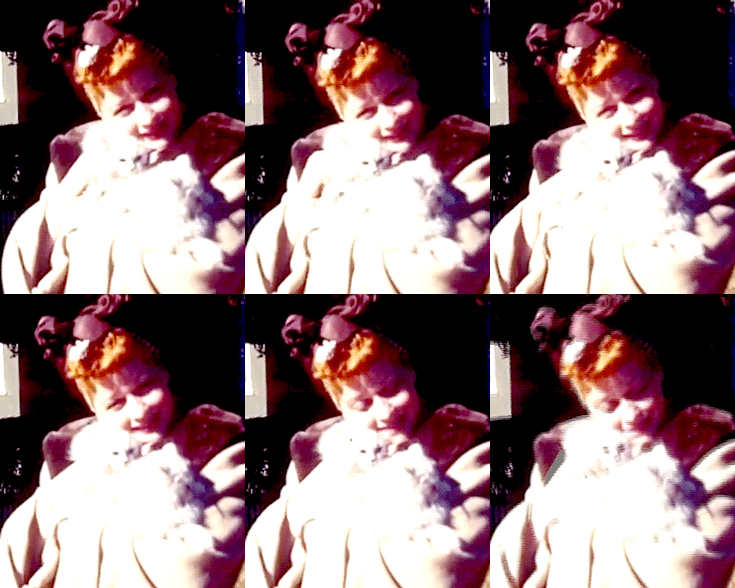
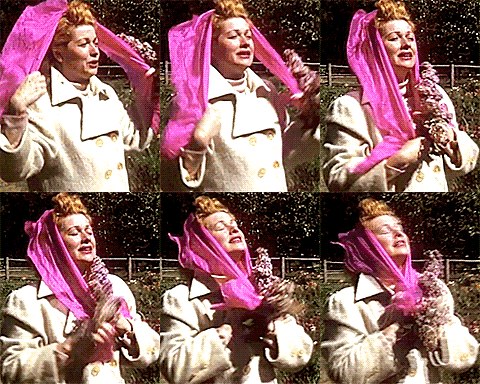
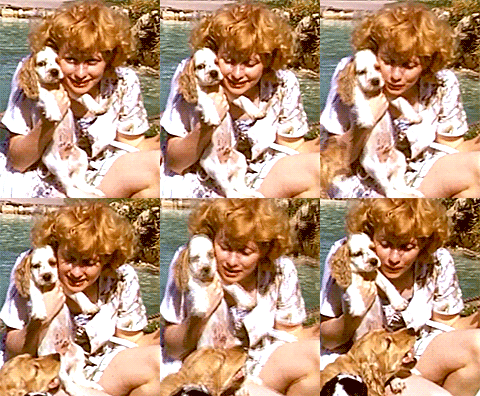
In the home movies, she is in her element. Most of them were shot by Desi, to whom she revealed herself to more than anyone else. Lucie Arnaz said in later years: "He knew her in a way that I don't think anyone else ever could." And that's apparent in the clips. Though she herself has attested to being happiest when she was working, the home movies show a side to her that even her best work (aka I Love Lucy) couldn't reveal. Her playfulness, her cuddling with her dogs and her cats, her quietness, her fears, naked and on display. She was an incredibly complex woman. But perhaps more than anything, the home movies shows all these facets in a raw light.

And that's the Lucy I love, the Lucy I look to each day for inspiration.

I'm not really sure what else to say. She means so very much to me, and I don't think, at this point, even words could express that. I'm not being sappy. It's the truth. I love you, Lucy. What's one hundred and two years? She's timeless.

Sunday, June 30, 2013

Funny Lady | The Evolution of Lucy Ricardo


The very lovely Movies, Silently blog is holding a Funny Lady Blogathon - how awesome of an idea is that? - and I of course signed up to write about my favorite lady of them all, Lucille Ball.

Okay, but what can I really tell you about Lucy and her comic genius that hasn't already been said countless times before? She is considered, more often than not, to truly be the funniest woman in the history of the entertainment business. And I'm sure few would dispute her position as being the First Lady of Comedy, opening the doors for nearly all the comediennes who followed in the path she blazed: Mary Tyler Moore, Valerie Harper, Carol Burnett, Tina Fey, Kristen Whig, Mindy Kaling - just to name a few. Just about everyone has seen the clip of her drunkly pimping Vitameatavegamin or the one of her furiously stuffing chocolates down her blouse, in her hat, and into her mouth at the candy factory.

For this post, I felt as if writing about I Love Lucy would be pointless, because I wouldn't be able to provide any new or groundbreaking information. I couldn't write something about her performance on the show that would be news to anybody. Instead, I thought I would write about how her talent as a comedienne grew over time - from the conviction in a little girl from upstate New York to make people laugh to October 15th, 1951, when I Love Lucy debuted on air. You could call it the evolution of Lucy Ricardo.

It's fairly well known that Lucille Ball was quite different than Lucy Ricardo. Lucy's real life humor was like that of, as her daughter Lucie once described it, "the fast talking broad of the 30s." In fact, real life Lucy was far more serious and adult than the childlike illusion she portrayed in Lucy Ricardo and extended to all of her long running television characters - Lucy Carmichael (The Lucy Show) and Lucy Carter (Here's Lucy).

But, despite this, Lucy always had an interest in comedy - long before television existed. As a young girl, her grandpa would take her brother and her to vaudeville shows, and Lucy was intrigued with the way the clowns could make the audience laugh. This sparked in her her first desire to act out, recalling later, "All I knew is that I wanted to make people laugh - I certainly didn't want to make them cry." She went out to Hollywood in 1933 as one of Samuel Goldwyn's Girls. When lined up for inspection by Eddie Cantor, Lucy applied little pieces of red felt to her face, so it would look as if she had chicken pox. Cantor laughed and enjoyed her little prank. She increasingly became known as the only girl willing to sacrifice glamour to take a pie in the face or preform any other physical pratfall to get a laugh. She christened herself and friend Eve Arden as "the drop gag girls." Pandro Berman told studio executives that she was "a really funny kid, great at parties" - but never thought that this talent would amount to anything. In a 1940 letter to then boyfriend Desi Arnaz, she wrote of a guest part on a radio show she was going to do because it seemed like "a funny role." Even in the home movies of she and Desi from the forties, she can be seen clowning for the camera and blacking out her teeth for costume parties.

Many of Lucy's earliest leading film roles - in the late thirties - are comedic, though studios widened her range in the forties and she appeared in comedies, dramas, musicals, even a Western. Her earliest significant role would probably be in Stage Door (1937); Gregory La Cava's highly acclaimed blockbuster about a handful of young girls trying to make in the business. The ensemble cast, headlined by Ginger Rogers and Katharine Hepburn, is easily impressive, also containing supporting roles filled by Ann Miller, Eve Arden, Gail Patrick, and Andrea Leads. Lucy doesn't preform any physical comedy in Stage Door but manages to hold her own, rolling her eyes melodramatically and delivering wisecracks with nonchalance. In one scene, Lucy is asked, "If it's not food, it's men. Can't you talking about anything else?" To which she replies, "What else is there?"

Stage Door boosted her career, giving way to supporting roles in A pictures for stars like Ginger Rogers (Having Wonderful Time, '38, in which one can also spot a young Henry Fonda) and Irene Dunne (Joy of Living). It also bolstered her to the role of a leading lady in B films, fastening her as a fixture in comedies with low budget actors like Joe Penner and Jack Oakie. One comedy from this era in her career is Go Chase Yourself (1938); like I Love Lucy in reverse, Lucy plays a irritated wife having to clean up the messes her scatterbrained husband, Penner, is always getting into. The film is a madcap screwball comedy lacking the necessary charm, and Lucy is, as usual, confined to quips and sarcasm, but she makes the most of it.

Whereas she played a housewife in the latter film, she was elevated to a more glamorous role in her next movie, The Affairs of Annabel (1938), in which she plays a movie star, Annabel Allison, a victim of the harebrained schemes contrived by her publicity agent, Oakie, to advance her career. Once more, the screwball is not her but the male character, however, Annabel did fairly well at the box office, and even spurned a sequel, Annabel Takes a Tour, in the same year. It gave Lucy a bigger helping of physical comedy than her prior films, and was likely the largest role she had to date. The New York Post commented, "The gal should go places."

Her next movie was Room Service (1938), with the Marx Brothers. In later years, many would draw correlations between the antics of Lucy Ricardo and the wild comedic group of the thirties, but at the time, Lucy's experiences with them were nowhere near life changing. The farce failed at the box office and was distinctively less pleasant and more sober than their earlier box office hits. As expected, each schtcik was handed off to the brothers, giving Lucy and co-star and friend Ann Miller not much more to do than run in and out of scenes, looking beautiful but frazzled. Lucy didn't particularly like any of the Marx brothers other than Harpo, who treated her the best of all, and was later given a guest starring spot on I Love Lucy (the famous and brilliant pantomime routine in the Hollywood episodes). Whereas she might have, still, been appreciative of their comedic talent, Groucho Marx didn't think much of hers: "Lucille Ball," he said, "Is not funny without a script."

In Next Time I Marry (1938), she played one of the famous ditzy heiresses of the thirties. It paired her with James Ellison for the first of two times, and had some decently funny moments, but over all was a mediocre comedy. Reviewers, however, took notice of her, calling her a "lanky and glass eyed comedienne" (The New York Times) and "as screwy and spoiled as any of Hollywood's poor little rich gals" (The New York Post) in the role.

What was particular about her next film was that it was a comedy-drama; Beauty for the Asking (1939) has several moments that gave way to her capability as a dramatic actress, which audiences had not really seen yet. New York Daily News wrote, "Miss Ball rises high enough above her material" - which she would continue to do so over the next decade of less than quality scripts -"to remind us that she is the stuff that stars are made of."

In You Can't Fool Your Wife (1940), Lucy was given a dual role as a housewife and as a Spanish seductress. She fakes an accent and dons dark hair, which is especially ironic when it would be later that year in which she met and married Desi Arnaz. She tackled the roles with ease and though the film is not particularly spectacular, it allowed for a slight expansion of her range. Critics continually praised her and sought a future for her that apparently, her RKO bosses did not see; at the time, even Orson Welles was interested in casting her as the lead in one of his projects that never came to be.

The rest of her run at RKO, resulted in her being cast in an array of different roles, from burlesque queen to ingenue to heroine of the western front. None particularly showcased her ability as a comedienne, and, in fact, her best performance at RKO was likely her turn as the paralyzed, unforgivably bitchy but beautiful Gloria Lyons in The Big Street (1942). Interestingly, this dramatic role was the one she was most proud of over the years, and critics were enthralled as well, writing that RKO should've wrangled her an Oscar nomination for the role - which never, of course, materialized.

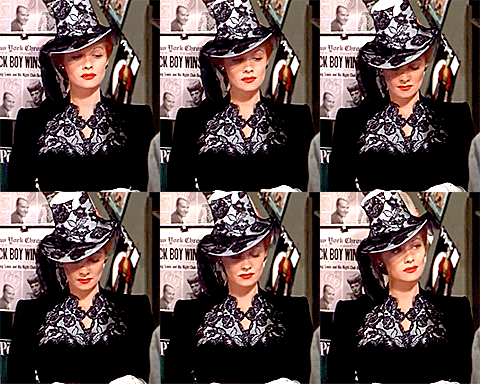
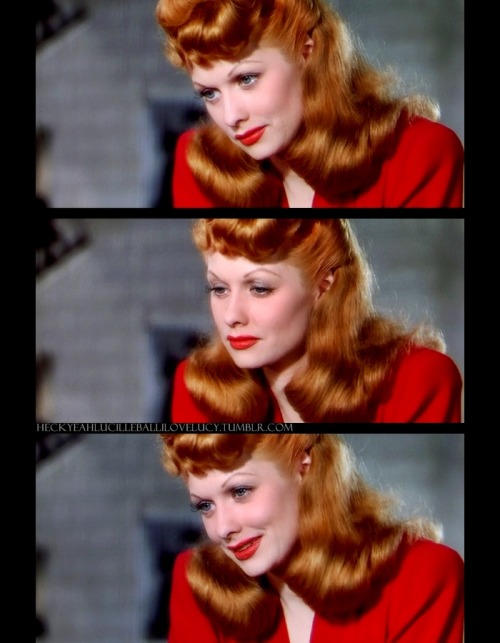
RKO couldn't make a star, but maybe MGM could - that was, in fact, her hope when she arrived at the studio in 1943. (Lucy wouldn't return to RKO until 1957, when she and Desi bought it). She was now thirty-two, and she had been in Hollywood for ten years, and though she had made her fair share of B pictures, she hadn't yet achieved star status. If anyone was going to do it, it was MGM, who had the biggest corral of actors or as they put it, "more stars than the heavens." Her debut role was DuBarry Was a Lady (1943), a musical in which she worked alongside friends Gene Kelly and Red Skelton, but it only notable for her change to her famous red hair. It gave her little chance for comedy, but did offer her an opportunity to show off her new tresses - she looks breathtakingly beautiful in the closeups of her leaned up against the piano while Gene Kelly professes his love to her in song.

Her next, most pronounced comedic role came three years later with Easy to Wed, MGM's remake of the popular Libeled Lady. She was given the Jean Harlow role, and it was easily her best chance to shine as a comedienne to date. Esther Williams took Myrna Loy's character, and Van Johnson William Powell's. Though the film falls completely flat next to the stunning original, Lucy stole every scene, doing justice to the character (one that had switched from a bottle blonde to a hennaed redhead) that the late Harlow had made so famous. She is given the opportunity to play totally drunk, a foreshadowing of Lucy Ricardo getting smashed on Vitameatavegamin, the bit easily the most entertaining and vivid in the whole film. She looked the part of the beautiful clown, her red hair and blue eyes making her a knockout in the Technicolor print. "Miss Ball all proves herself a superb farceuse. She snaps her lines over the heads of other characters and in pantomime manages to be as scatterbrained and indignant as a wet hen," wrote The New York Herald-Tribune. "Very special honors go to Lucille Ball for her topnotch comedy scenes which highlight the film," said Film Daily, and The Los Angeles Times agreed, citing her comedy as "the most compensating feature of this production - she is her super best."

But Louis B. Mayer's philosophy was that "funny women don't sell tickets, beautiful women do." She made one more picture for MGM, a film noir, before being released from her contract. Certain that her career was over, she soldiered on, free lancing for a period with the help of her agent Kurt Frings. She did a series of dramas and her next light fare was not until Her Husband's Affairs (1947). Reminiscent of Go Chase Yourself from nearly a decade earlier, as well as a backwards version of I Love Lucy, Lucy plays a wife constantly saving her husband, Franchot Tone,  from his own self in this less than perfect film . "Lucille Ball, an able an comedienne," said The New York Times of her performance.

In the years just before I Love Lucy's 1951 debut, she would play a mixture of roles, but some stand out as being as close to Lucy Ricardo as she would ever come pre-Lucy. Miss Grant Takes Richmond (1949) is a prime example. She plays an empty headed secretary hired by William Holden (six years before the infamous pie in the face) who unknowingly becomes a prop to front for Holden's "business"; he is in actuality is a bookie. Her absentmindedness sets off a string of calamities. The movie gave Lucy the liberty to do a great deal of physical comedy. Early on in the film, she struggles with her typewriter ribbon to a comedic hilt, nearly destroying the machine, wasting practically a stack of paper, and covering herself in ink. Like Lucy Ricardo, her character, Ellen is lovable - Holden can't help but fall for her - and has good intentions, but is naturally inclined to cause trouble wherever she goes.

In 1950, she made Fancy Pants alongside her best pal, Bob Hope, a movie that reached all heights of absurdity and prompted Cue to call her, "one of the finest comediennes in Hollywood." That same year, in a true precursor to the physical comedy she would execute on I Love Lucy, she made The Fuller Brush Girl. Her character plays a door to door saleswoman (think Avon Girl), and much like Lucy Ricardo unwittingly attracts trouble when she witnesses a murder. The results are disastrous, and she and her husband end up in a string of ruses to avoid being blamed for a crime they did not commit, including hanging precariously from a clothing line, a slapstick striptease number she is forced to preform and a wild goose chase on a ship. Lucy proved that she was fearless when it came to physical comedy, preforming all of her stunts with wild abandon, as she would do on her television shows for years to come. The repercussions were harmful. She reflected, "I sprained both wrists and displaced six vertebrae, then irritated my sciatic nerve...I also suffered a two day paralysis of the eyeball when talcum power was accidentally blown into my eye by a wind machine. A three day dunking in a wine vat gave me a severe cold, and I was also bruised by several tons of coffee beans." But the reviews for her comedy, written by critics who unknowingly were watching Lucy Ricardo form before their eyes, were excellent. "Miss Ball carries the ball for comedy touchdown," wrote The Los Angeles Times. "Lucille Ball, with her wide eyed beauty and buoyant charm, puts over her comedy with perfect timing, and just the right amount of pathos and bewilderment to arouse the film goer's sympathy while she keeps them laughing," praised The Hollywood Reporter, a description equally fit for Lucy Ricardo.

Lucy made one more movie, a strange Arabian nights sort of farce for Columbia, before going on air in October 1951 in I Love Lucy. Needless to say, the show took off like gangbusters and Lucille Ball, who had struggled in B roles and mediocre films for nearly the past twenty years in Hollywood, her comedic talent ignored by studio moguls but noted by reviewers - shot to stardom.

Starting in 1948, Lucy had been molding Lucy Ricardo on radio as well. She was the star of My Favorite Husband, a program about Mr. and Mrs. Cooper and all the jams Mrs. Cooper got Mr. Cooper into - if that sounds familiar, it's because the show became the basis for I Love Lucy. Originally, the Coopers were the Cugats and Liz Cugat was more of a socialite than a middle class housewife. But that was before Jess Oppenheimer, a veteran of Fanny Brice's program, was brought to work on the show - he and writers Bob Carroll and Madelyn Davis worked to make the character of Liz Cooper more wacky and screwball, much like the character Baby Snooks. All three went on to make I Love Lucy the success it was.

Her work on My Favorite Husband widened her comedic range more than any of her prior film roles - and this is clearly evident in the three comedies she made during the run of the program, discussed above. Not only was she funny with just her voice, but she learned how to play to the live audience the program was recorded in front of - it also gave birth to her famous "spider face." Lucy learned to love the audience, and they in return adored her. Over the years, this bond only grew stronger, intensely symbolic of America's affection for her, a relationship that lasted on her sound stages for three decades. By the point of Here's Lucy, Lucy got rousing applause from the audience only for walking onto the set - their laughter for even the most neutral of lines, one observer later noted, was their way of telling her, "We love you."

Though Lucille Ball was not much like Lucy Ricardo, a part of the famous character was being conceived in her from the very start - in the little girl who just wanted to make people laugh. In her screwball film roles of the late thirties and the forties, one can see as her ability as a comedienne grows, the progression of Lucy Ricardo seems to lie under the surface, climaxing in the late forties thanks to funnier film roles and her radio show, and finally resulting in what we all know as I Love Lucy.

Monday, October 15, 2012

61 years later, we still love Lucy

61 years ago on this day, on a Monday night, at 9 PM, I Love Lucy went on air and has never gone off since. I wrote this post a few weeks ago with the intentions to post it earlier, but then decided to hold it off for the 15th, though I hadn't necessarily planned to do a post about the show's anniversary this year (as I did one last year for the big 6-0). Anyway, here's the post, I hope you enjoy it, and don't forget to squeeze some Lucy into your day today.

***

A couple of weeks ago, I happened to come across an article that wondered if we had finally reached the first generation not growing up on reruns of I Love Lucy. It wasn't the main topic of the article (and it was a pretty rubbish piece, anyways), but, to be quite honest with you, it did scare the hell out of me. As a classic film fan I am well aware of this generation's lack of appreciation of yesteryear's Hollywood, but I have always also felt that there are exceptions to the rule - movies, and, in this case, TV shows, that have defied the odds and still manage to be remembered by the greater part of society today. Like Gone With the Wind. Casablanca. The Wizard of Oz. Actresses like Audrey Hepburn & Marilyn Monroe. It's well known around these parts that I'm not always a fan of the idea of an "icon", but I have learned to be grateful for the "iconization", if you'd call it, of these films and people because it does keep Old Hollywood alive. It's nice to know that there are certain things that give Classic Hollywood and yesterday's entertainment a face, even if there is so much more beyond the face. Know what I mean?
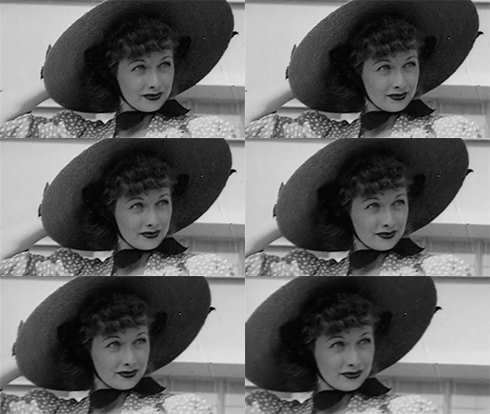
I have always seen I Love Lucy as one of these exceptions. Why not? By many, it is considered the greatest television show to grace the small screen. It seems that at some point or another, just about everyone has seen an episode, or has at least heard of it. Even before I came to watch the show, I knew it existed - it was exactly what I thought of when thinking of "classic television." So many of the episodes are famous in their own individual right, and everyone seems to know them - "the Vitavetavegamin one ," "the candy factory one," "the grape stomping one"... the list is seriously endless.

So, no, I couldn't really bring myself to believe that this was a generation not growing up on I Love Lucy reruns. I remember sitting in the hairdresser's chair a couple of years ago as he recounted having nostalgically caught an episode of the show a few days before while channel surfing. Or going to a family party and meeting a family friend of my age who could remember seeing - and enjoying - at least a few episodes. Or the other day in school, where one of my new friends asked who the face on my iPhone case was (yes, I have a Lucy case) and another said, "It's Lucy from I Love Lucy, see?"

Still, as I said earlier, frankly, the very thought that Lucy had reached a generation which demeaned it less timeless as all the generations before it scared me. A lot. But a couple of events have fully assured me that that article was just as rubbish as I thought; and that over sixty years later, we still love Lucy very much.

Out of my curiosity, I decided to do my own little test of Lucy's popularity. I don't know how many of you readers are on Tumblr or aware of how it works (follow me; loving-lucy!) but a popular game on Tumblr is to do a sort of "Reblog if you love ___" post and see how many notes it gets. Now, I knew I wouldn't be able to get the most accurate of results because despite definitely having a nice, faithful group of followers, I'm most definitely not "Tumblr famous." Still, I decided to give it a try; Tumblr's target audience is teenagers/people in their twenties, thus people of 'this generation.'

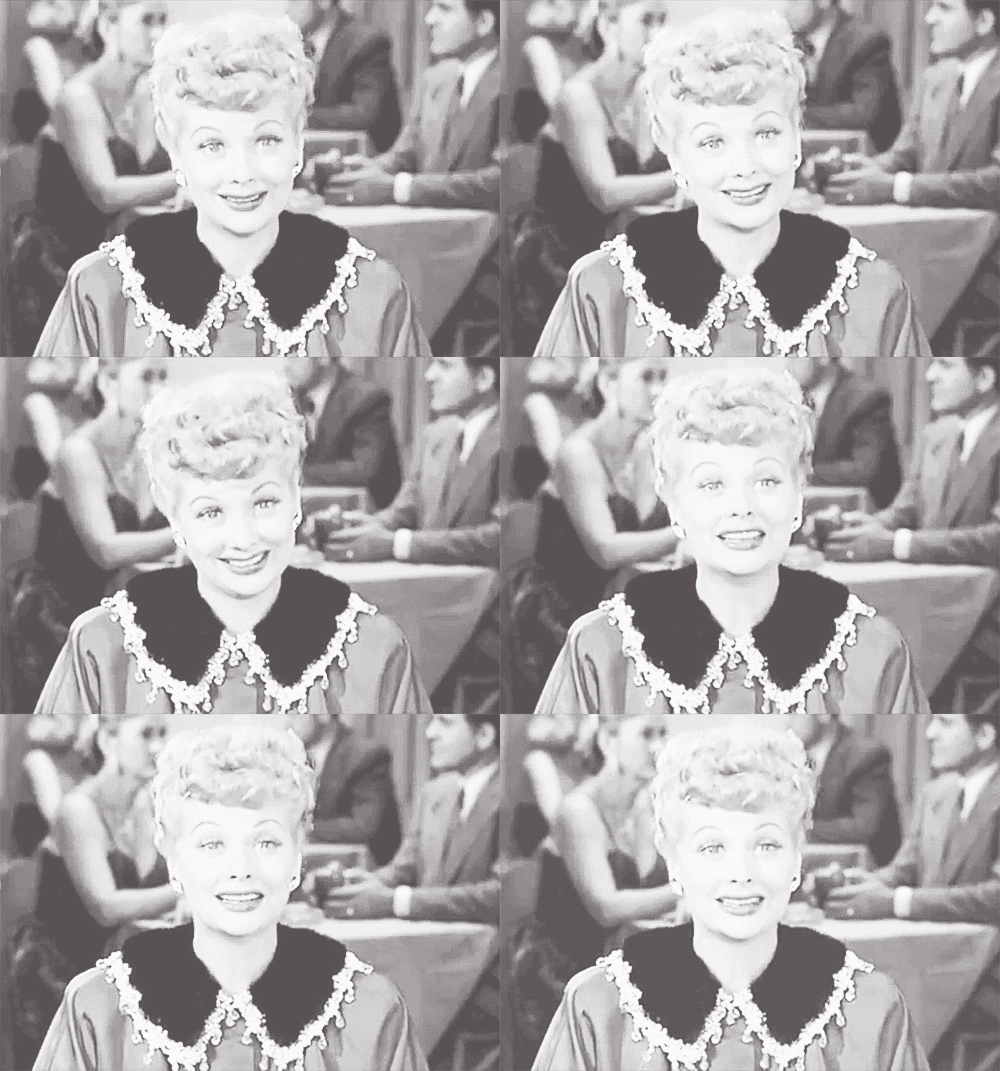
[my GIF]
The post has so far gotten well over a thousand notes, but better than the notes were the comments that people added when reblogging the post. "This show was my childhood", "I know them all by heart", "Lucille Ball is my idol" and "I'm watching it right now" appeared frequently; but best of all were the specific memories or emotions the show provoked.
I Love Lucy has been my favorite show since I was 8 years old. I’ve seen every episode more times that I can count and somehow it’s always just as funny as the first time I ever watched it. The show is timeless and I refuse to believe that future generations won’t find the joy, wonder, and laughter that Lucy has brought into my life and the lives of many others. - melodylingerson
I thought I Love Lucy reruns were like…eternal. This show is incredible and I have the fondest memories watching it with my grandparents. - curlyqshoo
If you are not growing up on I Love Lucy, you are doing it wrong. And by “it” I mean life. - grahamburgers
This show was and always will be genius - and I think it would shock people of my generation (and younger) how much of the comedy we see today is referenced or based off this amazing show. - obamayourmama
Heck, some people even said they'd personally educate this generation with DVDs of I Love Lucy - others refused to ever raise children in a Lucyless society! One reblogger added that her mother had gone into labor with her while watching Lucy, while others remembered being little kids and watching the show with family members; knowing that when the theme song ended it was time for bed. Anecdotes like those proved to me what I'd fully suspected.

What was also beautiful to read were messages users left for me in my tumblr inbox. They might not necessarily apply to members of "this generation", but attest to the joy Lucy has given many, and what an incredible tool laughter is.
My grandmother runs her own home for women with Alzheimer's and dementia and watching these women watch I Love Lucy was one of the most rewarding experiences of my life. Some of these women can't respond to their name being called but would just laugh until they were in tears when Lucy would come on. It was so beautiful. Just thought I'd share. ciarakenadie
 I work at a nursing home and they have the Alzheimer's unit. You can't even imagine how hard life is for them. BUT, Everyday the one thing that they remember is I Love Lucy is on. They all rush to the meeting room to watch I Love Lucy on the tv. We only have about five episodes but they just watch them over and over again. It is a beautiful thing it always makes me a little teary. - xprincessdiana
About a month ago, Barbara Walters hosted a 20/20 special entitled "Best in TV," to count down the best television shows of all time (or, the past sixty years anyways) as chosen by the public. This was split into various categories: Best Comedy, Best Drama, Best Cop Shows, Best TV Mom, etc. with a top five for each, and it was topped off with what voters chose to be the Top 5 Greatest TV Shows of All Time. Obviously, I tuned in with fingers crossed to see Lucy might win.

The results were just as I could have hoped for; Americans chose Lucy as their favorite comedy as well as their all time favorite television show. There was a nostalgic ten minute monologue for the show to cap off the special. ABC News collaborated with People magazine for this, and the magazine's editor likened Lucy to the Book of Genesis in television - "In the beginning, there was Lucy." In the monologue, we were reminded of some incredible facts: that Lucy has been translated into seventy-seven different languages, that it is the most watched television show to date, and CBS still makes millions of dollars off the show per year. (Originally, Lucy & Desi owned the episodes, and then sold them back to CBS in 1957 for four million dollars, giving birth to the rerun. Of course, Lucie & Desi, Jr. still hold interest in their parents's images and the many requests they get to use them with "Desilu, too")

On the special, Betty White summed up what Lucy did for women in comedy in one statement: "You had this gorgeous, gorgeous woman who did all these funny things." Isn't this true? Because of Lucy, women have all the opportunities in television and comedy as they do now, and they don't have to appear "unflattering" to be comedic. Whilst flipping through the channels the other day, I caught a bit of a Julia Louis Dreyfus sitcom, and I couldn't help but notice how much her character's wacky resourcefulness reminded me of Lucy Ricardo. Then, come to think of it, almost every comedic female character on television today has a little bit of Lucy Ricardo in her: that screwball spirit, that touch of sarcasm, that goofy steak. That's how deep the influence runs. And besides that, Lucy was a pioneer in the television industry in technical ways that are still apparent today, too. They invented the three camera technique that is still used by most sitcoms today, gave birth to the rerun, and came up with solutions for many of early television's obstacles in lighting & set design.

Lucie and Desi, Jr. were interviewed by Barbara for the special. At the end, Barbara asked Desi, Jr. what he thought it may be that makes his parents's show still incredibly successful sixty years after first going on air. I think he explained it very well when he said it is the show's principles that are timeless: laughter, friendship, and love.

So maybe there are some jokes that just never grow old.

At the end of the day, I've thankfully come to the conclusion that Lucy is still very much popular and very much needed. What was significant about that 20/20 special? Americans voted for their favorites, and Lucy came out on top - not but critic's choice, but by people's choice. In a 1984 televised event, Sammy Davis, Jr. told Lucy with great affection: "You are the one that they love the most." Call me biased, but he was very likely correct.

But why do we still need Lucy? The world has changed so much since when Lucy & Desi owned the airwaves. It's become more explicit, for sure - you couldn't say 'pregnant' then, but now you can air a woman actually giving birth. It's become a busier place and lacks the warmth that we once had. But this difference between their generation and ours is, I think, the very reason we still need Lucy. The world still needs Lucy because is something familiar that comforts us with the best memories of the past, and gives us something to smile about, even if for only twenty-four minutes. I'm sure there are only a few who, having watched even a single episode, haven't smiled or giggled or laughed at least once.

I guess the only way to end this post is to say two words to the cast, and, primarily, that beautiful redheaded girl who starred in the show: thank you!

"The world not only loves Lucy. The world, as it is today, needs her very much."
[my GIF]

Saturday, August 25, 2012

Gene Kelly Centennial | Du Barry Was a Lady (1943)

This is an entry for the Gene Kelly Centennial Blogathon, hosted by the Classic Movie Blog Association, to celebrate the 100th birthday of one of Hollywood's best hoofers (Gene's actually birthday was the 23rd). Go here to read the rest of the very fabulous entries. Thank you to the CMBA for hosting!


***
I was a little late to the party when signing up for this blogathon, and needless to say, the best of Gene's films had already been grabbed. So unfortunately, this will not be the astute opportunity for me to ramble on endlessly about my love and affection for one of my favorite movies, Singin' in the Rain (1952). Instead I have chosen for a less well known vehicle from earlier on in Gene's career, Du Barry Was a Lady (1943) - it is, alas, no where near the perfection of Singin' in the Rain, but it does costar Lucille Ball, my favorite of all people, and thus I have chosen it to discuss today. 

Du Barry Was a Lady (1943) is the story of a hat check man who is in love with the beautiful nightclub headliner at the club he works for. She, in turn, has the hearts for a poor dancer, who reciprocates her affection, but she knows she must marry for money. The hat check man strikes it rich by winning the Irish sweepstakes, and asks his crush to marry him, which she agrees to, even though she doesn't love him. The moral of all of this is brought to light when the new heir gets slipped a mickey and dreams his is in 18th century Versailles, in which he is King Louis XV, adamantly pursuing Madame Du Barry.  

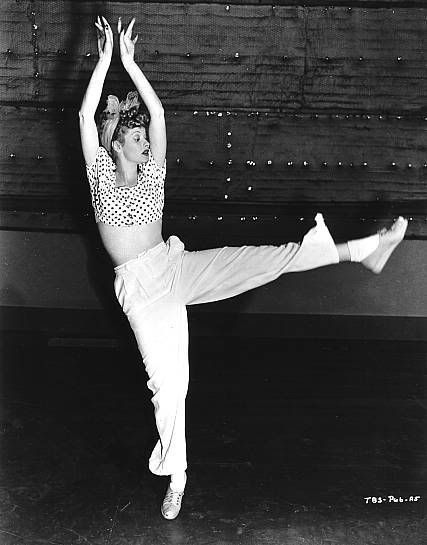
Lucy practicing one of her dance routines
for the movie backstage
The film was more of a prominent milestone in Lucille Ball's career rather than Gene's. She was cast as the nightclub star May Daly/Madame Du Barry in what was her first film at MGM. She had failed to reach star status at RKO (though she had garnered the title as queen of B movies), and everyone knew - Lucy included - that MGM was her last chance to become an established movie star. As her introduction to the MGM corral of actors (after all, MGM had "more stars than the heavens"), she was cast in this film, which had been a successful Broadway play starring her good friend Ethel Mermen. It was called out to be a lush, Technicolor production, with a roster of songs by Cole Porter. To give Lucy a new image, MGM's chief hairstylist to the stars, Sidney Guilaroff, dyed her hair a stunning shade called "Tango Red", that popped on the Technicolor print, but Lucy herself was not quick to like in real life. (Lucy, born a brunette, had been dyed a Harlow blonde, then a strawberry blonde, which gradually darkened to mahogany brown). Critics were quick to call her "Technicolor Tessie," and declared no actress had looked better in color. Needless to say, Lucy kept this shade for the rest of her life.

This was the second film for budding star Gene Kelly, who obviously played the down on his luck hoofer, Alec Howe. Though only a year younger than his on screen love interest, Lucy had a list of films under her belt whereas this was only the second in what would prove to be a legendary show business career. (One could argue that both Gene and Lucy struck it big in the early 50s, Gene in his most well known film Singin' in the Rain - in '52 - and Lucy a year earlier with I Love Lucy.) Before this, Gene had made his screen debut with For Me and My Gal (1942), which he had made alongside bona fide star Judy Garland. Red Skelton is the third and final co-star, as the lucky hat check man Louis Blore.

The above mentioned are also supported by Virginia O'Brien, a fairly underrated actress in her own right.  Jo Stafford can be spotted as a member of the "Pied Piper" bind, as well as Ava Gardner for a second or two as a perfume girl, and Lana Turner makes a guest appearance as a part of one of Red Skelton's singing sketchs.

Despite the pretty impressive cast, and the cosmetic milestone this was for Lucy, the film ultimately fails to hit the mark (despite doing well at the box office), and I don't think it was a movie that neither Lucy or Gene could look back at and fondly remember. In fact, it might as very well have been one they tried to forget. Though it would for Lucy (because of her hair color change), this movie would also hold no later prominence for the birthday boy, Gene. But as contract players must, both were cast in this film with no questions asked.

This is actually, believe it or not, a movie I own on DVD - it's a part of TCM's Lucille Ball collection. When I offered to my dad the chance to watch this again in preparation of this post, he absolutely refused. And I can't blame him, because this is a real turkey. There are some pros to this film but there are tons of cons, too. (Because, even I couldn't get myself to sit through this again).

You might put the first problem of this film in the plot, which is pretty kooky. There's nothing wrong with "fun nonsense" movies, but sometimes they work and sometimes they don't, and this time around it's a case of the latter. This film is actually decent until Red Skelton gets konked back in time where he appears as King Louis XV and Lucy as Madame Du Barry, the king's notorious mistress. There are some interesting scenes, like one in which Red's King Louis chases Lucy's Du Barry around a bedroom, which includes a shot of them jumping around the bed (which, was, in fact, a trampoline - a scene Lucy didn't very much enjoy shooting as it gave her nausea!). As you can imagine, this was a number that went under the close eye of the Hays Code Office; but this film is the squeaky clean all around besides (though, according to my Lucy at the Movies book, the play was a bit raunchier and was sanitized a little before being transferred to the screen).
A promo shot for Du Barry, 1943
I think after the main cast gets shot back to Versailles in the 1700s, the film actually becomes pretty unwatchable, or at least, that's how I remember it. Still, the plot is ridiculous anyways and you couldn't put the fault in any of the cast. Obviously, everyone on here knows what I think of Lucy and I think pretty highly of Gene Kelly and Red Skelton, too - all very talented actors, and they do the best they can.  Ultimately, they are misused. Gene doesn't even get to dance as much as he could've!

So while we can conclude this is certainly not a five star movie, there are a couple of good things about this movie, too. As I said above, the actors give it their best shot. Lucy looks so gorgeous in this. It's always hard for me to pick what was period was the height of her beauty, but this would be one of the top contenders. She sports a blonde wig upon her DuBarry transformation, however, shows off her new hair color in the rest of the film, and the critics weren't kidding when they raved about the new 'Technicolor tessie.' Really, the closeup shots of her as Gene professes his love with a song are killer.

The songs in this movie are by Cole Porter and while it might not be the best work of the famed songwriter, the numbers in here are certainly decent. The most notable is probably "Friendship," the happy song-and-dance number sung by the three title actors at the end of the film. Gene obviously did his own singing, but Lucy was dubbed for all the numbers in this film by Martha Mears - with the exception of this song, for which she did her own singing. The song would also later be used on the episode of I Love Lucy where Lucy and Ethel preform on television for their women's club benefit. They sing the song while they shred each other's identical dresses to pieces!  (It should be added that, unfortunately, a great deal of music from the stage play was emasculated.)

I looked long and hard to find any particularly interesting backstage stories to liven up this post about a very mediocre movie, perhaps about Lucy and the birthday boy, but I could come up with nothing. Gene Kelly, though still in the early stages of stardom, is one of the few truly notable costars Lucy worked with before she had her success in television. He and Lucy would work together three more times. In the same year, they both made appearances in Thousands Cheer, a variety film that lacks plot but is made up of skits and sketches. Then, once again in Ziegfield Follies (1946), a similar film filled with an assortment of routines, but they are in separate skits and don't share any screen time together. (Lucy is in only in it for a few minutes, but I did watch the whole movie and it was interesting - some skits are better than others; there's some nice singing by Lena Horne, Judy Garland does a fun routine that mocks Greer Garson's ladylike image, and a very notable piece where Gene and Fred Astaire dance together!). Gene Kelly also directed Lucy in her short stint in his film A Guide For the Married Man (1967). (And as for Lucy and Red Skelton - when Red won the Emmy in '52 for Best Comedian or Comedienne, he said, "You gave it to the wrong redhead tonight.")

As for Gene Kelly himself, unfortunately, this wasn't one of his better films - and so it's probably silly I chose this movie to discuss on his 100th. All the while, Gene is definitely a performer I love. He was an incredible dancer and watching him preform, he in as an art all by himself. He was very initiative when choosing his routines, and his good looks and charm made him appropriate for more sultry dance moves that Hollywood's other premiere dancer, Fred Astaire, strayed from. He also influenced so much of modern dance; Michael Jackson credited Kelly's influence numerous times. That little scar on his cheek? I've always loved it, because it added a certain degree of ruggedness and a dash of allure. Some say that Astaire was more elegant or debonair, but I think they were two entirely different dancers and it isn't very fair to compare them; they were both beautiful in their craft. And besides, Gene Kelly's lines were just as neat and pretty as Astaire's.

Gene Kelly was fabulous and I adore him to bits. This film may not be incredible, but plenty of his other movies were: first and foremost, Singin' in the Rain, but also Anchors Aweigh (1945), On the Town (1949), and An American in Paris (1951) (amongst many others, I'm sure.) So here's a big happy centennial birthday to one of Hollywood's best. Thanks for the dances, Gene (and all my apologizes for the numerous times I diverted this post over to Lucy, but I think it's okay because you worked with her enough to know how incredible she was!).


Happy 100th birthday, Gene Kelly. 


Monday, August 6, 2012

Happy Birthday, Lucy ♥


Today, Lucille Ball would have turned 101 years old.

What can I say about her that hasn't been said? She was incredible. She touched the lives of so many people - and continues to. She passed away twenty-three years ago and yet she still seems very much alive. When Sammy Davis Jr. toasted her on a televised "all star party" in 1984, he stated, "The sun never sets on Lucille Ball," and he was entirely correct. Maybe it's because that at any time of the day, some where in the world, a television set is playing I Love Lucy. Maybe it's because her face has been seen more often by more people than any other person who has lived.
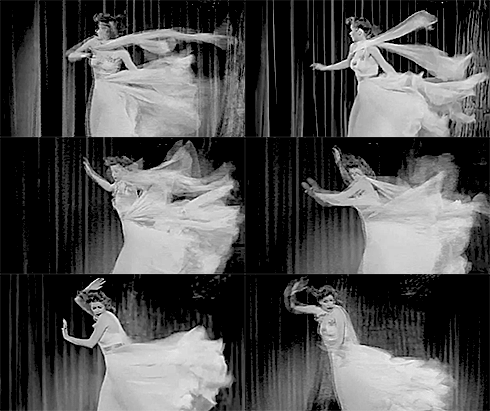

Or maybe it's because the public never saw her as a "star." No doubt she was one, one of the brightest in the galaxy, but our (the audience's) relationship with Lucy was different than going to the movie theater to watch a feature film. Lucy visited us in our homes, in our living rooms, weekly, just like a friend or a family member. In the days long before VHS and now, DVD, Lucy began what was to become perhaps a infinite, intimate relationship with us. You watched Lucy on in your own home, on your sofa, with your family. You were safe in knowing that there would be happy ending. For many people, Lucy is like that best friend we can always count on. We didn't call her "Lucille Ball"; we called her "Lucy." She's one of us. 

"The red hair, the giant eyes, the rubber face: Those were the physical tools that Lucille Ball used to ply her comic craft so expertly. In the process of trying to make people laugh, she also stole their hearts… The depth of feeling for Ball spoke to the power of the medium she helped popularize…Viewers around the world formed an intimate bond with the comedienne, thinking of her not as a star, like Bogart and Bacall, but as part of their extended family who dropped by on Monday nights," said Vanity Fair, best explaining our love affair with Lucy. 

Was there any other person who so helped shaped television? There were many who also started out in the medium's infancy, but none who have risen to such fame as Lucy. I read an article last year, on the occasion of her birthday, that acknowledged her comedic talent but put the question, "Why Lucy?" Its author wondered why none of the other early pioneers of television are so applauded as she. While this may seem unfair, it was something that occurred naturally. From the 1950s, audiences have taken akin to Lucy with a great passion, and continue to do so while those other television shows have faded into our past. She had a special quality, a certain 'it' factor, that made her the darling of the public.  And while there will continue to be television programs that are just as popular and actresses who will win more Emmys than Lucy, it was Lucy who was there at the start. "Let’s face it: any comic actor on TV today, male or female, who claims not to have been influenced by Lucy/Lucille is lying through his or her teeth," said TV Guide. And they were right. Without Lucy, there would be no Carol Burnett, Mary Tyler Moore, Betty White. There had to be someone to set the wheels turning. 


Before Lucy, comedy had always been a man's profession, but she challenged this stereotype. "Bob and I once told Lucy that  she was a beautiful clown. She didn’t want to hear it because it embarrassed her, but it was true. She might be dressed in a baggy suit and a battered top hat and wearing big, funny shoes - but she was still beautiful," Madelyn Pugh Davis, scribe to many Lucy projects but most famously I Love Lucy, wrote in her autobiography. Lucy's comedy was tasteful and she never compromised her femininity. "She was such an amazing clown, we sometimes forget she was also such a beauty. Ball went from bombshell to grande dame, but she never relinquished her crown as the all-time queen of comedy," said TV Guide.

There is a song, Where Were You When the World Stopped Turning? referring to the 9-11 attacks. In it there are lyrics representative of a person's reaction to first hearing of the attacks. Did you turn off that violent old movie you're watchin' - And turn on "I Love Lucy" reruns? This makes sense for, Lucille Ball and Lucy have always been a comfort to us. There will always be that sense of security in knowing you can laugh until your sides hurt, but there will always be a happy ending - Lucy & Ricky will kiss and make up. Maybe this lyric corresponds to this quote: "The world not only loves Lucy. The world, as it is today, needs her very much," which was penned in 1976, about thirty-five years ago. And in the decades that have passed, I think we can come to the conclusion that we need Lucy even more now than we needed her then. Besides the fact that comedy has lost class and finesse and has quite often resorted to sex and racism for laughs, the world is constantly changing. It does sounds cliche to say it, but we're lost in our digital age, we're whistling in the dark, and we could all use a laugh now and then.


We love Lucy because she was far more than a "star." We love her because she's our Lucy, our favorite redhead, the beautiful clown, the girl we can always turn to no matter what. She is timeless. To me, it is unfortunate that only a few stars from the Golden Age are still vividly remembered in the general society (rather than a smaller cluster of film buffs). These are the icons, and they will always live on no matter how long they've been gone. Lucy is an icon, but it's not because she died prematurely or took a famous photograph - it's because of the years and years of laughter she has left us. We love her and thank her with our laughter, and she loved us back, and though she is gone, she has left us many a valentine.


Now that I have talked about what she meant, and continues to mean, to the world on the public stage - I want to reflect on what she means to me personally, which is a lot.


Have you ever looked at someone for the first time, and yet there was something about them that made you just love them? You could call it "love at first sight," I guess, but that sounds really cheesy. Anyways, that's very nearly what happened with Lucy, from the first episode I saw of I Love Lucy, I was infatuated with her type of comedy, for it was something I've really never experienced before, and I was taken with her. How could you not, because she looked like a living doll - with those humungous blue eyes and cupid's mouth - and all the while this beautiful lady was preforming the most hilarious of pratfalls and delivering the wittiest of lines with the best of them.


I don't think I can even explain how much I love her, because I really do have a deep affection for her, even if it seems silly. I don't think it's frivolous because I don't think I'm alone in this sort of a love for her. And I feel like it makes perfect sense to love her for all she's given me. In my really sad moments, she's the only the person who can cheer me up. I love to laugh; and I love to laugh hard, it's one of my favorite feelings in the world, but I don't always laugh easily. Silly jokes and dumb gags never get me, but Lucy always does. And how can I not love someone who has given me so much laughter? "One of the greatest gifts to mankind is laughter, and one of the greatest gifts to laughter is Lucille Ball," Bob Hope said.

When I'm a fan of a person, I must actually love them both in their profession and in their personal life. This is perhaps unnecessary - I've heard many a person say, "They're a wonderful (insert career) but a terrible a person" - but it's just something I can't help but do. I can't feel happy in enjoying someone who was good in their craft but then realizing I can't respect them in reality, which is why I think of many of my favorite actresses not just performers I like best, but people I truly admire. And Lucy is on the top of that list. There are, obviously, many actresses I have a great affection for but Lucy always is first, no matter what, no matter who I'm currently obsessing over, she's always my number one.

She's my role model, even though I have no plans to become a actress or a comedienne. It is more that I desire so many of the qualities she exhibited that got her to the top. I don't think any ultimately successful actress had such a long and bumpy road to stardom. Lucy faced so much failure in her path, so many people who told her she wasn't better than average, that she couldn't do it, etc., but she never let any of this stop her. And she had patience, so much of it, which is a virtue I'd easily give an arm and a leg for because I don't have it. She had drive, determination, and passion. When she was fifteen they kicked her out of drama school because she wasn't on the same par as her classmate, Bette Davis. They told her mom she was "wasting her money" because Lucy had "no talent." If I were in her shoes, I could imagine feeling like my whole life was coming to an end, but Lucy simply got back up and decided she'd climb the ladder in her on way. She modelled and became the face of Chesterfield cigarettes until a talent scout picked her up to be one of Sam Goldwyn's girls. She went out to Hollywood and never came back.

Even there, though, it was difficult. When she began to get starring roles, they were in B pictures. So many, in fact, she was nicknamed "Queen of the B's." When RKO was through with her, they sent over to MGM, who consequently dyed her hair its famous red color and tried to make her a star. But it was seemingly like trying to jab a square peg into a round  hole, and it didn't work. Everyone knew that MGM was Lucy's last hope at becoming a star, and within a few years they, too, dropped her. She then free-lanced, but still never rose to the title of a "movie star." By the time she became world famous, she was forty. Yet she never regretted or looked back on these years with remorse; she instead took it as a learning experienceFor, because she was a B movie queen, she wasn't typecast like the A list stars but put into any sort of vehicles that the studio wanted to put in. So, Lucille Ball in the 1940s made dramas, comedies, film noirs, musicals, and even a Western. She never refused to do any sort of gag or costume, even if it made her seem unglamorous. 

She took risks and she never let anyone tell her she couldn't do something. Going into television was a big risk; because in those early years of the medium, Hollywood saw it as their biggest rival and a war was waged. Lucy knew that if she went into television and she failed, she wouldn't be able to fall back on her lukewarm movie career. And there was her insisting that Desi should play her husband, even though CBS felt that no one would buy them as a couple. They had to go on tour with a vaudeville act to prove their point, but make it they did, and now "Lucy & Ricky" are probably the most famous television couple of all time.


I love her home movies. For those of you that may be unaware of this, in 1993 Lucy & Desi's daughter, Lucie, made a documentary about her parents to refute a disgusting TV movie that exploited their worst faults. In it, she used private home footage of the couple, personal film taken with their own cameras, mostly at their ranch in California. In this, we see Lucy totally candid and raw; what she was like outside of the public's eye, because she likely never excepted these home movies to become public. (Not to sound as if I'm rebuking Lucie for doing it; I'm SO glad she did). She's unscripted, she's herself, and this is the Lucy I love best. Frolicking around the ranch in costumes, making funny and kissy faces at the camera, cuddling playfully with Desi, snuggling with her cats and dogs. I feel like these clips tell more about the private Lucy than any biographer could ever try to.

I think I'll close this post with some of my favorite Lucy stories. I have many, but here are just a few that I think best reflect her personality.

There was the time that Barbara Eden had a role on one of the final episodes of I Love Lucy. (If anyone needs a refresher, she would later play Jeannie on I Dream of Jeannie). She was supposed to play a suburban siren, and the dress the set had chosen for her was tight and showed off her curves, but dull looking. Lucy decided to make it more glamorous, and so within breaks, she spent the entire time with her assistant manually applying little rhinestones all over the dress so it would sparkle and look more beautiful. 

Lucy was loyal with her employees, whether they worked for her on set or at home. She hired her housekeeper, Harriet, in the early 1940s and kept her for decades. As time passed, Harriet grew protective of Lucy, and their relationship was more than employer and employee, but friends, gin rummy partners, and confidantes. Whenever the two were in the Bay Area they would drop by Harriet's best friend's house. Her name was Dot, and she had a little girl named Barbara. Knowing Lucy loved barbecue, Dot would make ribs. "I kept staring at this beautiful lady eating messy ribs," Barbara recalled.  She also added, "Lucille loved children and she always treated me like a princess. She had her dressmaker make me pinafores and she sent socks to match. My mother was afraid I would be spoiled rotten, and I was. Lucille made people feel important in her company, because if she liked you, she loved you." Barbara also remembered her mother and aunt Harriet reminiscing about their dancing days, and Lucy about her Goldwyn days, and then they would "push the furniture back and form a chorus line, laughing and giggling and dancing." When Lucy visited Barbara some years later, Barbara had by then given birth to a son. Lucy, who had suffered several miscarriages, was still childless at the time and yearning for one of her own, so she doted on the offspring of others. Barbara recalled of this visit, "When she met my son, she loved him so much she kept stuffing money in his pockets. He was five or six and she thought it a great game."

I think that's the type of a lady she was, and that's why I love her so much. The most beloved performer? Easily. I know it sounds biased coming from me, but I think it's true. It will never be fair to judge the  "best entertainer", because they were all unique and special in their own ways. But "beloved" means  "a much loved person", and our admiration for Lucy was never basking in her intimidating glow, as if she was an idol or a diva, as it with some stars - but true love and affection. She didn't just entertain us, she gave us love. She gave us laughs and smiles. 

I can't think of a really good way to wrap up this post, so I think I'll just end this post with something simple.

Thank you, Lucy, for all the laughs you've given us. Have a very happy birthday and know that we'll always love you. Thanks to television, we'll always have you. And your memory will always be very much alive because you were just that amazing; you'll never be forgotten.

Happy birthday, my queen. 


"I have had every big star come on my stage through the years. Looking back, I have to say that the most beloved star by the American public was Lucille Ball. No one else has captured the hearts of the people out there the way Miss Lucille did, and probably never will again."

- ED SULLIVAN -

Happy Birthday, Lucy


[NOTE: all GIFs in this post are mine]

Thursday, April 26, 2012

Lucy Remembrance | 1911 - 1989

Today marks the 23rd anniversary of the day Lucy passed away.


Lucille Desiree Ball 
AUGUST 6TH, 1911 - APRIL 26TH, 1989


I'm always more then a little upset on this day. Some may think it's a little bit pathetic to be genuinely sad on the anniversary of your favorite actress's birthday, but I could care less what others think. Lucy, to me, is more than "my favorite actress." She's one of my role models, one of the human beings I admire the most, and having loved  her ever since I was nine I feel like I know her. It's more personal than someone could imagine from the outside looking in.

My love, respect, and admiration for her is something that's hard to explain. I'm going to try to put it into words the best I can. When I see her on the screen, whether it's in one of her brilliant television shows or a not-so-good B movie from her RKO days, she just makes me want to smile. It's the way she is on screen, how happy she seems to be there to entertain you and she's enjoying it. When I watch Lucy, I know she "gets" it. She's not just acting for a paycheck, she's doing it because it's an art, and she understands that and respects it. 

Perhaps it's because she had to work so hard for it. If anyone knew what it means to persevere, it was Lucy. When she was fifteen, her mother managed to put aside enough money for Lucy to start establishing herself as an actress by entering a dramatic school. But the school didn't like Lucy. They were already enamored with their star pupil, somebody named Bette Davis, and they sent Lucy home, telling her mom, DeDe, that she was "wasting her money." Can you imagine how Lucy might've felt after that? I would be hurt, and I would feel like it was all over. But not for Lucy. She was determined and she got into the business anyway.

When she was in New York pounding the pavement, she took a job modeling at Hattie Carnegie's so she would have money to eat. She became so overworked she was terribly sick and sent home by Hattie herself. They discovered she had a crippling arthritis, and for a long time Lucy was in bed. She had to learn to walk all over again. She was in her 20's when this happened, on the brink of everything, and I can imagine how much of a setback this might've felt like. As everything had been derailed. But she was a fighter, and she dealt with it, and she did it. She learned to walk again, and she returned to New York, and her job, and eventually became one of Sam Goldwyn's girls in a chorus line - and made it to Hollywood.

But even upon getting there there was numerous setbacks. When she finally started to get leading roles, they were all B movies. One after the other, real turkeys, when, looking back, Lucy is the only significant actor. One of the main reasons was because a important producer had wanted to leave his wife for Lucy, but Lucy refused to do so despite the benefits it would have to her career. She knew the man had kids and she couldn't stand to see the children be hurt. Despite her refusal, his wife find out about the offer, and blacklisted Lucy's name throughout RKO. (It is said the producer might be Pandro S. Berman).

But she pushed on. Even her marriage to Desi is an example of her determination. I love the two of them together so much, as you all know, but even I can't deny that that marriage had serious problems. Yet she continued to try and make it work for twenty years, which is a long time, especially in Hollywood. Many have noted how loyal Lucy was. She kept the same housekeeper, nanny, driver & hair stylist for decades. I think in the similar way she was loyal to people, she was loyal to her acting projects. This made her a perfectionist, and, for some, hard to work with - but Lucy was a woman who gave it her all, and continued to do so even after she became a star. I have so much respect for her because of all of this.

Lucy is underrated. No, I'm not kidding, she is. Sure, she's definitely largely appreciated for her comedic talent, anyone with a sane mind will admit that. But she is underrated for many other things: her dramatic ability, for one. She wasn't just a comedienne, she was an actress. Watching her in roles pre I Love Lucy will show you this. As I said before, many of these are terrible films, but these varied roles show off Lucy's incredible talent as an actress. I hated The Big Street (1942), and yet the same time I can appreciate it because of how amazing Lucy is in it. Her role is unlikeable, a total b*tch to be honest. And yet I'm glad to see her in this steel cold role. It shows how well she could do drama, and she really could do it wonderfully.


People never take note of the fact of what a versatile actress she was. When she was a B movie star, she was put in all types of movies: comedies, dramas, film noir, musicals. Yes, even the latter, though she couldn't sing. And even though oftentimes the script was terrible and her co-stars not that great, she made the best of it, and in the end she always shone.

Besides this, she's underrated for her beauty. Because she was a comedienne, people choose to ignore this fact all the time. But as Bob Hope said at the 1989 Emmy's, "she had a beautiful face, made for comedy. Nobody looked better with a mouth full of peanuts or a blouse full of chocolate." Or, as Desi put it, "She could preform the greatest physical comedy without losing her feminine appeal." The writers of the show, Madelyn Davis and Bob Carroll, called Lucy a "beautiful clown". In her autobiography, Davis wrote that this made Lucy blush but it was indeed true - even when she was wearing a baggy suit, battered top hat, and big funny shoes, she was still beautiful.


Still, above all this, comedy was indeed her greatest talent. It was just a part of her and I think it always was. When she was a kid, she used to go to vaudeville shows with her grandfather and admired the ability the comics had to make the audience keel over in laughter. She wanted to be able to do the same thing, make people laugh, and she indeed had that gift. She was excellent at physical comedy and made the most wonderful facial expressions, but those were just assets. She didn't need them. She could be funny even with her voice - just listen to any episode of My Favorite Husband, the 1940s radio show that eventually became what we know as I Love Lucy on the small screen.

Every time I watch her in an episode of I Love Lucy, I'm just in awe of her comedic talent. Just the other day I was watching, and taking awe of her brilliance as a comedienne. That's really the word for it. Honestly, Lucy Ricardo gets into the wildest, wackiest situations that are in many ways reminiscent of screwball comedy. Hilarious but unlikely. But I think a part of what makes I Love Lucy so funny is that Lucy played her character so that she was genuinely believable. Even as he was drunkenly trying to sell Vitavetavegamin or stuffing chocolate down her blouse in a mad hurry, you could believe it. It's not things that you could imagine actually happening to you, but perhaps it was the little things that made it seem that these situations were realistic.

Take the scene from the episode "Lucy Does the Tango." Lucy has eggs stuffed down her shirt because she's trying to hide them from Ricky. He wants to practice the tango they're going to do for Little Ricky's PTA, which ends in a dramatic move where Ricky spins Lucy out, then throws her back in and crushes her against him. But her shirt is full of eggs! She does the routine, anticipating what's going to happen in that fateful final moment all the while. It does indeed happen, and the eggs smash and her blouse is dripping with yolk. As Ricky stares at her, his eyes bulging, while Ethel cringes and the audience roars with laughter, Lucy crosses her arms over her dripping shirt and tries to look casual, as if anyone could have eggs stuffed in their shirt. That little motion made the scene altogether funnier, and, believe it or not, realistic. This was the scene that contains I Love Lucy's longest laugh: 65 seconds long.

The other day, Bette wrote a post about what it's like to rediscover just how wonderful your favorite star is. I mean, you know that you love them, but then there are sometimes these moments that remind you just why they're your favorite. And with Lucy, this happens to me all the time. Just seeing a picture or reading a piece of trivia puts a smile and reminds me just how much I love this lady.

Lucy loved and greatly admired Diane Sawyer, which is ironic because I always tell people I "want to be Diane Sawyer when I grow up" (I love journalism). She never met her, but when she died her family and friends sought Diane for her eulogy, and she complied. It was titled, Is There Laughter in Heaven? Diane herself answered this question in the eulogy: "I believe that there is laughter in heaven because Lucille Ball is there."

So every year on this day, I try not to be upset but instead smile. We may no longer have her on this Earth, but thanks to I Love Lucy, she will never ever be forgotten. Each generation is discovering her just as audiences did in the 1950s. And it may sound like a cliche, but heaven really did get an angel that is making everyone 'upstairs' laugh until their stomach hurts. It's something to smile about indeed.

Each year on this day, I think of it as another full year that there has been laughter in heaven.


"Yes, you are the one that they love the most Lucy. Joy requires no translation. God wanted the world to laugh - and he invented you, Lucy. Many are called, but you were chosen."

- SAMMY DAVIS, JR.

***

I made this for her, too, if anyone is interested. 

Is there anything you love about Lucy the most?

Friday, March 2, 2012

Happy Birthday, Desi! [5 Things I Love]

So, you may or may not know that today would've been Desi Arnaz's 95th birthday.

Desi has is a very controversial subject to many; a lot of people don't like him because there was a womanizing and drinking in his marriage with Lucy. So much so that it overrides what Lucy and Desi's relationship really was: perhaps one a little unstable, but a love that really was forever. And since Lucy was the star of the show, people never really give Desi credit for the things he did for the show, and he did so much. True Lucy fans love him because we know that Lucy did, and Lucy wanted him to be appreciated, and most of all, that Lucy loved him a lot.

Therefore, here's five things I love most about Desi :)


Happy birthday, Desi!
·      "We all know that Lucille Ball was the great female comic genius of the twentieth century, and that their show, I Love Lucy, which in my opinion is the most important television show ever produced, was a perfect showcase for her tremendous talent. What we don't often appreciate is that Desi was the man who understand her talent and knew exactly how to spotlight it; if I Love Lucy made history, it was especially because of Desi's genius as a producer. The television we watch to this day is based on a format he created to help his wife be her very best. The three cameras, the filming instead of going live in New York, the studio audience, the concept of reruns - all of it show Lucy into the stratosphere. All of it shaped the next sixty years of television production. Practically all of it was his idea. All if it exploded a system that even the studios hadn't fully appreciated, but he did.
                                                                                                                                                             

All of it born from this Cuban man, being so totally Cuban that he sang songs in Spanish every week on national television (another breakthrough with huge impact: say thank you, Gloria Estefan and Shakira) this Cuban man that was told people wouldn't buy him with an American wife (never mind they'd been married for years), this Cuban man invented the sitcom as we know it. All of it stemmed from the love of one man for one woman, putting truth to the very statement that I Love Lucy was never just a title. Aren't we lucky that it happened? Aren't we lucky that it was true?" 


- Raul Esparza


***
#5: The accent.
Honestly, who cannot love that accent? The "dun't"s  - don't - and the "thin"s - things - all of it! So much so that a lot of Ricky Ricardo speak filters into my everyday speak. I say "dun't" all the time now and people don't even comment on it anymore, I honestly think they expect it. ;) Anyway, I'm a big fan of pretty voices ( *COUGH* Greer) and best of all accents (*COUGH* Ingrid), and Desi's voice is such a wonderful mix of that. 


#4: The music.
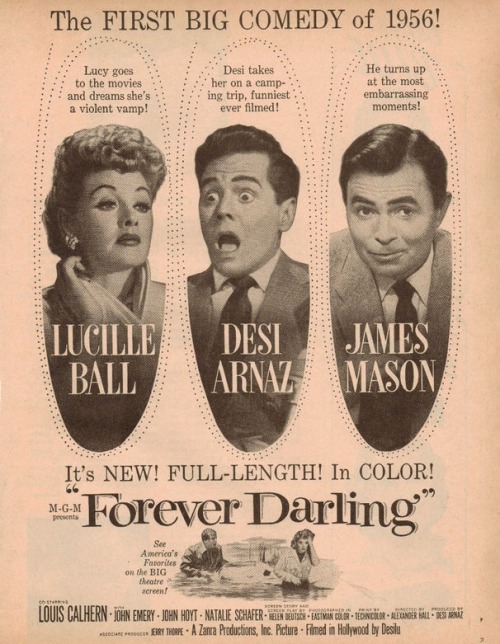
I think the most famous song of his would have to be "Babalu", obviously, but those avid Lucy watchers will remember a lot more. I have oftentimes listened the Lucy is Enciente episode as my favorite, because of the moment in the end where Lucy and Desi's real tears came through. Another thing that made that part so sweet was Desi's rendition of We're Having a Baby - My Baby and Me. It's adorable, and I know all the lyrics. And if you think about it, and pay attention to the club numbers on the show, there are a lot of really good routines. Like "Jezebel" from Lucy is Jealous of Girl Dancer and "The Waters of Minnetonka" from The Indian Show. I think my personal favorite would have to be one that wasn't sung on the Lucy show - at least, not more than a few bars of it ; it's the main theme from Forever Darling (1956), entitled, appropriately, "Forever Darling." It's lacking Desi's usual latin tunes, but it's still a wonderful, sweet song I think.


#3: His relationship with his kids.
Both Lucy and Desi wanted to have kids desperately, but it took a long time for it to happen to them. Lucy suffered five miscarriages. When they finally did have children, they were blessed with two: Little Lucie and Desi, Jr. (1951, 1953, respectively). When I was watching the home movies, Lucie and Desi, Jr. talked about what it was lying having two parents who were wonderful people, but didn't get to be around home as much, or, if they were around, were fighting. They also admitted that Lucy's mothering instincts didn't come as easy to her, probably because she had grown up a lot without her mother. (Lucy's mom, Dede, was a wonderful woman but since Lucy's dad died when she was four, Dede was gone a lot, holding down jobs and working. Dede was, however, there for Lucy a lot in the second half of her life). Desi, though, was a very fun father, they said. Desi, Jr. described him as the type of guy who was in awe with everything, and wonder at the beauty of nature - the type of guy who would point out the sunset and say, "God really outdid himself tonight." Despite what others say, Lucie and Desi, Jr. always talk very fondly of their dad, and I think that really says something about him. (Not to say Lucy wasn't a good mother. I'm sure she really, really was. And I could never say something bad about my dear like that!).


#2: His business smarts.
As the quote back up there really proves, Desi was the brain behind I Love Lucy. He really did sit up the sitcom as we know it today: the studio audience, the three camera technique, the rerun. Lucy might have been the star on the screen, but Desi really did put his all into being president of Desilu Studios. Lucy once told Carol Burnett that when she was "married to the Cuban" she "never had to worry about a thing" because Desi was "so damn smart about everything." And he really was, and out of everything, I think this is the ultimate thing he never got enough credit for. He seriously built up the format for how to film a sitcom. On an episode of I've Got a Secret on which Lucy and Desi were making an appearance, Lucy was reading a scripted intro for Desi, part of which described him as a "great producer." Lucy cut away from her script and daringly added, with a wink, "If you don't believe it, I have two little Arnazes at home to prove it!" ;) He truly was one of the best producers, though.
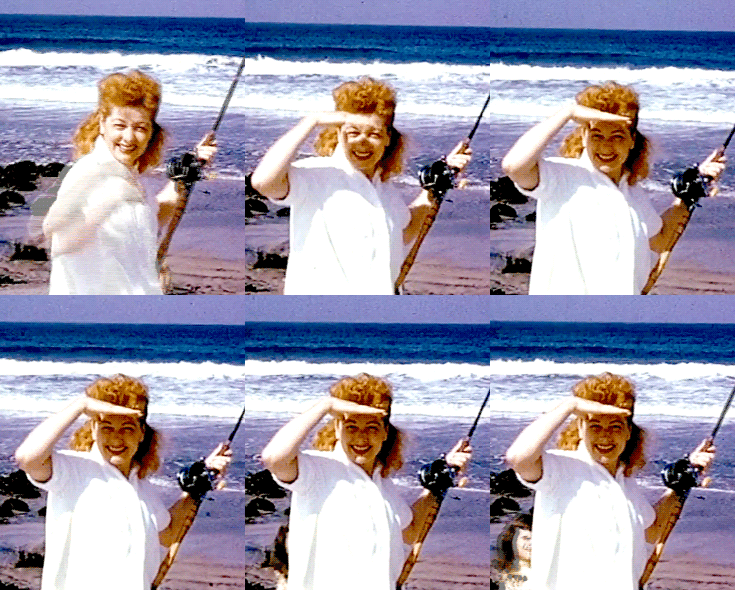


#1: His love for Lucy.
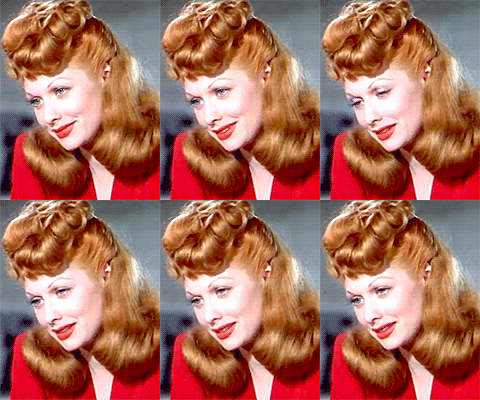
I've talked about this a billion times, and every time I do, I get caught up in the feelings that are all Desilu! Despite the drinking and the womanizing and the other issues, they still had an incredible love for one another. I think to be able to love each other as much as they did - even after the divorce - despite all the obstacles they faced is truly incredible. Desi's infidelities are often credited to the way he grew up; that love and sex are two different things and little things here and there don't matter. It was sad that it had to be this way, and it's what ultimately broke them apart, but above all their love was an incredible thing. He did love her a lot. As the quote says, I Love Lucy came out of Desi's love for Lucy. So even though things weren't always smooth sailing for these two, he wasn't kidding when he said, "I Love Lucy was never just a title." He loved her a lot.

***

Well, that's it for today! I hope you had/have a lovely day and happy birthday to Desi :)